

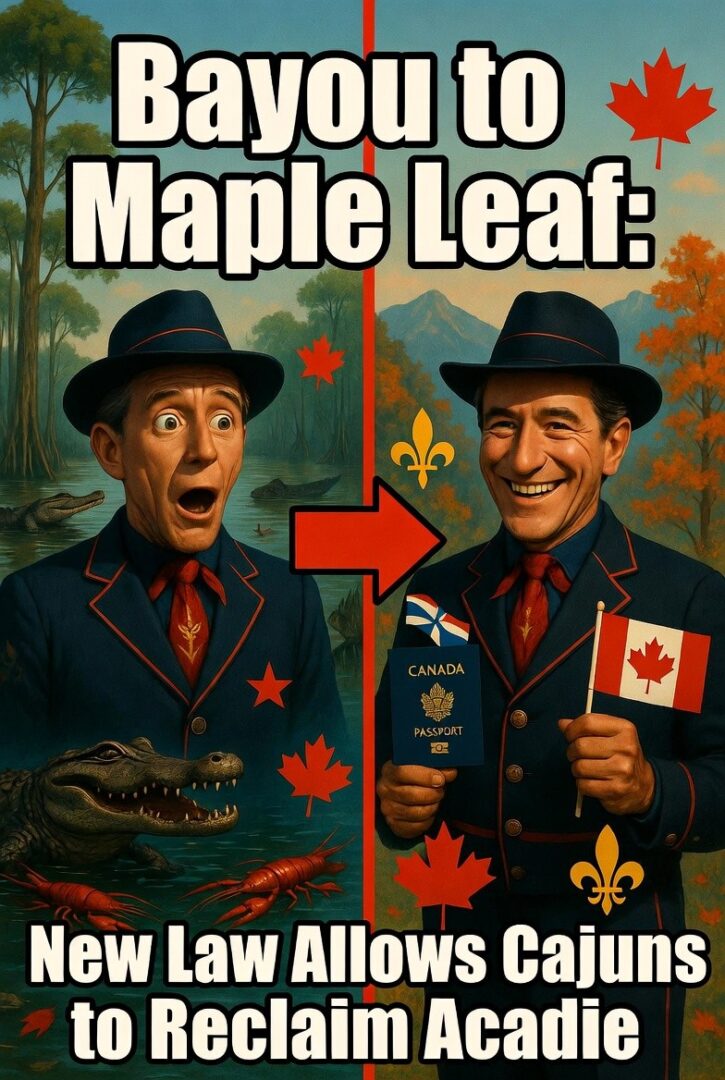
The British expelled Acadians from Canada long ago, but Canada has restored their Canadian citizenship through bill C-3, which went into effect December 15, 2025.
This law seems to make almost every descendant of a Canadian ancestor, no matter how many centuries ago the ancestor lived, a Canadian citizen. It applies even to ancestors who lived in Canada in the 1600s. It applies to anyone born in Canada except under diplomatic immunity. It does not require ever visiting Canada, or going through a naturalization process, or declaring allegiance to Canada. No action is required to receive the citizenship, which has already been granted, but it is only recognized by the government of Canada when it has approved an application for a Canadian citizenship certificate. The certificate costs $75 CAD ($52 USD), and requires a passport photo and exacting proof of an unbroken line of descent from a specific Canadian ancestor to the applicant. Professional genealogists can be expensive, but you can pool costs with cousins and 2nd cousins, and amateur genealogists love to volunteer.
If a Canadian citizen never establishes residency in Canada, the citizenship does not impose any obligations or duties. Citizenship does not have tax implications for those without Canadian income, and Canada does not have a draft or a selective service system. Be aware that if a person does choose to establish tax residency in Canada, an expensive exit tax applies if you later change your tax residency to another country.
Benefits: Even non-resident citizens can…
-vote in Canada’s federal elections if they’ve ever lived there
-use a Canadian passport
-begin to schedule free health care immediately after moving there
-Pay domestic rates for Canadian colleges ($3k USD per semester, minus scholarships)
-take a job in Canada
-retire there and continue to receive your US Social Security checks
-If Alberta & Saskatchewan ever become independent, having Canadian citizenship beforehand could be key to getting an immigration status there
A.I. estimates there are 2 million Americans who consider themselves French Canadians, and tens of millions more who have at least one line of ancestry tracing back to French Canada. Including British Canadian ancestry adds tens of millions more.
Après le Dérangement, l’Arrangement : Canada undoes the great expulsion with a great Rétablissement!
“Almost!”: Ways that a chain of descent can be (is) broken:
-One of the ancestors in all of your ancestral chains linking you to Canada became a naturalized citizen of a non-Canadian country at one point from January 1, 1947 to February 15, 1977
-One of the ancestors in all of your ancestral chains linking you to Canada sent the government of Canada a renouncement of citizenship
-Being born after December 15, 2025 if neither parent was born in Canada and neither is a Canadian who has spent at least a total of 1095 days in Canada.
-Grok claims that one of your ancestral lines must have a connection to Canada after 1946, but we weren’t able to determine the accuracy of this claim, so do further research before investing heavily in our findings.
Practical tips:
If you choose to apply, don’t be confused by the wording of the websites. As we understand it, if your parent is descended from a Canadian, then you are a child of a Canadian citizen parent even if they haven’t applied for a citizenship certificate and never even knew that they are now considered a citizen by Canada. Those are called “lost Canadians.” Don’t be confused by outdated websites, since the law is only 6 months old. A.I. answers rely on them. Immigration.ca is not a government website.
If you want to use your Canadian citizenship, apply for a citizenship certificate. Americans can enter Canada without a Canadian passport. If you want one, you’ll need the signature of a Canadian who already has a Canadian passport and has known you for 2 years.